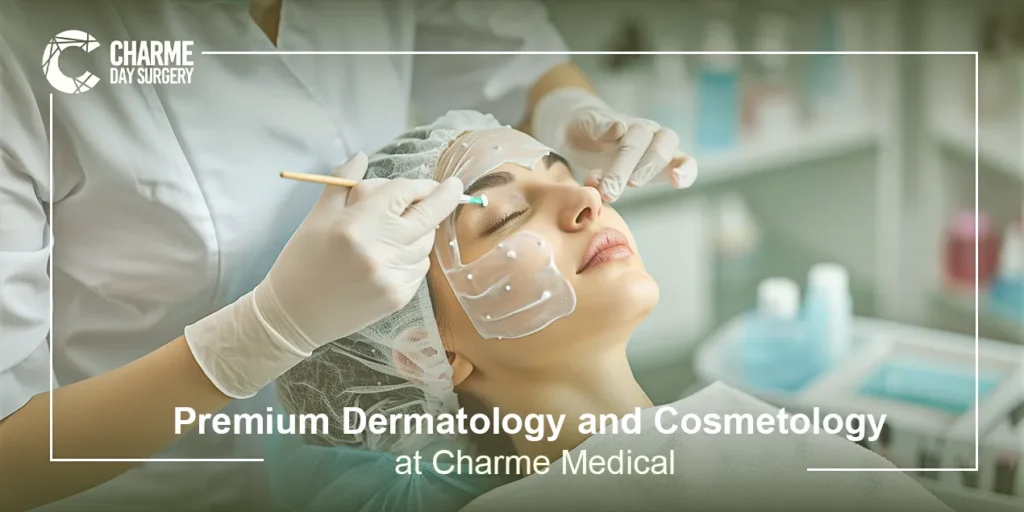
The fields of Dermatology and Cosmetology represent a dual approach to the human body’s largest organ: the skin. While dermatology focuses on diagnosing and treating pathological conditions, ranging from chronic inflammatory diseases like psoriasis to the early detection of skin cancers, cosmetology applies medical science to enhance aesthetic appearance and reverse physiological markers of aging.
Whether visiting an anti-aging clinic for rejuvenation or consulting a skin specialist for a persistent rash, understanding the clinical mechanisms behind these treatments is essential for safety and efficacy.
Leading Dermatology and Cosmetology Center in Dubai
A leading center is defined not only by its technology but also by its adherence to evidence-based protocols and the “Patient-First” philosophy. In such a facility, diagnostic tools, such as digital dermoscopy for mole mapping, are integrated alongside advanced aesthetic platforms like fractional lasers.
The goal of a specialized center, like Charme Medical, is to provide a holistic “Skin Journey.” This begins with a clinical assessment of the skin barrier (the stratum corneum) and the underlying dermal structure before any cosmetic intervention.
A healthy skin foundation ensures that treatments such as Botox and fillers deliver natural, long-lasting results without compromising tissue health.
Medical Dermatology Treatments available in Dubai clinics
Medical dermatology is the cornerstone of cutaneous health. It addresses the “biology of the disease” to restore the skin’s functional integrity.
Acne, Eczema, and Psoriasis Care
These three conditions represent the majority of dermatological consultations.
Acne:
Beyond topical retinoids, modern care involves managing the hormonal and inflammatory pathways. For severe cases, oral isotretinoin remains the gold standard, though light-based therapies are increasingly used as adjuncts.
Eczema (Atopic Dermatitis):
Treatment focuses on “barrier repair” therapy. Clinical research from the Société Française de Dermatologie (SFD) emphasizes the use of ceramide-dominant emollients and, for recalcitrant cases, biologic agents like Dupilumab.
- Psoriasis: This autoimmune condition requires systemic management. Modern dermatology has shifted towards IL-17 and IL-23 inhibitors, offering high rates of skin clearance with a favorable safety profile compared to older immunosuppressants.
Mole Mapping and Removal
Preventive oncology is a vital branch of dermatology. Mole mapping (digital dermoscopy) allows high-resolution documentation of nevi (moles). By utilizing AI-assisted tracking, we can detect minute changes in symmetry, border, and color that might indicate early-stage melanoma. If a lesion is deemed suspicious, surgical excision with histopathological analysis is the only definitive course of action.
Cosmetic Injections (Injectables)
Injectable treatments have revolutionized the anti-aging clinic by providing “liquid” alternatives to invasive surgery.
Botox for Wrinkles and Hyperhidrosis (Sweating)
Botulinum Toxin Type A (Botox) is a neuromodulator that temporarily inhibits the release of acetylcholine at the neuromuscular junction.
- For Wrinkles: It is primarily used for “dynamic” wrinkles, those caused by muscle movement, such as crow’s feet and forehead lines.
- For Hyperhidrosis: Injected into the axillae (underarms) or palms, Botox blocks signals sent to sweat glands, providing 6–9 months of relief for patients with excessive sweating.
Dermal Fillers (Lips, Cheeks, Jawline)
Unlike Botox, dermal fillers are “volumizers.” Most modern fillers consist of Cross-linked Hyaluronic Acid (HA).
- Indications: Restoring mid-face volume loss (cheeks), defining the mandibular line (jawline), or enhancing the vermillion border of the lips.
- Safety Tip: We emphasize that fillers should only be injected by a licensed professional who understands facial anatomy to avoid rare but serious complications like vascular occlusion.
Skin Boosters (Profhilo & Amber)
Skin boosters represent a new category of “bioremodeling.”
- Profhilo: A high-concentration stabilized HA that spreads through the tissues to stimulate four different types of collagen and elastin. It does not “fill” but rather improves skin “laxity” and hydration.
- Amber (Succinic Acid + HA): This combination focuses on “redermalization,” improving cellular metabolism and reducing pigmentation while hydrating the skin.
Know more about: Endocrinology Treatment
Laser Skin Treatments
Light-based technology allows for precise targeting of specific skin structures (chromophores) without damaging the surrounding tissue.
Laser Hair Removal (Full Body)
Modern laser hair removal utilizes the principle of selective photothermolysis.
- The Technology: The Alexandrite (755 nm) laser is ideal for lighter skin, while the Nd:YAG (1064 nm) laser is safest for darker skin tones (Fitzpatrick IV–VI).
- The Process: To achieve permanent hair reduction, patients must undergo multiple sessions to target hair follicles in the anagen (active growth) phase.
Fractional Laser for Scars & Resurfacing
For acne scar treatment, the Fractional CO2 is the gold standard. Instead of “stripping” the entire skin surface, the laser creates microscopic thermal zones. This triggers a massive wound-healing response, replacing scarred tissue with fresh, organized collagen. It is highly effective for “ice pick,” “boxcar,” and “rolling” scars.
Non-Surgical Facelift & Rejuvenation (HIFU)
HIFU (High-Intensity Focused Ultrasound) is a breakthrough for patients seeking a lift without the downtime of a rhytidectomy (facelift). HIFU delivers focused ultrasound energy to the SMAS (Superficial Muscular Aponeurotic System) layer, the same layer surgeons tighten during a traditional facelift.
By inducing thermal coagulation points at specific depths (1.5 mm, 3.0 mm, and 4.5 mm), HIFU stimulates long-term neocollagenesis, resulting in a tighter, more lifted appearance over 3–6 months.
Practical Clinical Insights: PRP for Face
PRP for the face (Platelet-Rich Plasma), often called the “Vampire Facial,” involves centrifugal separation of the patient’s own blood to concentrate platelets. These platelets release growth factors (TGF-beta, PDGF, VEGF) that accelerate tissue repair.
- Clinical Efficacy: While highly effective for improving skin texture and treating androgenetic alopecia (hair loss), results depend heavily on the platelet concentration achieved with the specific centrifuge kit used.
Contact Charme Medical Center today to learn more about our comprehensive cosmetic services.
FAQ
What is the difference between Botox and Fillers?
Botox “relaxes” the muscles that cause wrinkles (best for the upper face), whereas fillers “fill” volume voids and deep folds (best for the lower face and lips).
How many laser sessions do I need for hair removal?
Most patients require 6 to 8 sessions spaced 4 to 6 weeks apart. This timeline is necessary to catch every hair follicle in its active growth phase.
Is PRP effective for hair loss?
Yes, PRP increases hair density and diameter by prolonging the anagen phase of the hair cycle, though multiple sessions are required for maintenance.